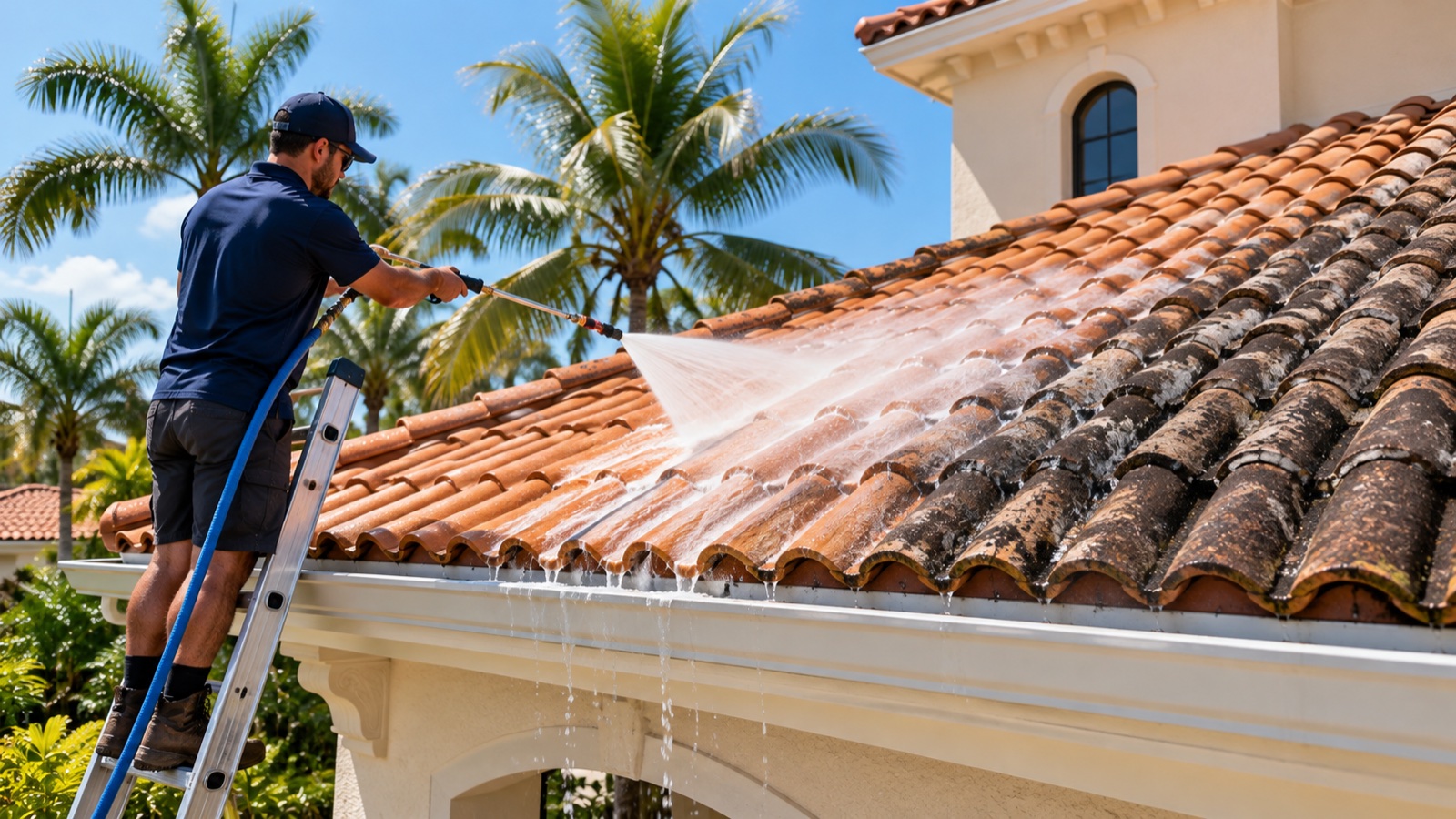
What's Growing On Your Roof
The dark streaks running down South Florida roofs are not dirt, staining, or age. They are Gloeocapsa magma - a cyanobacterium that photosynthesises like a plant and feeds on the limestone filler in asphalt shingles and the porous surface of concrete and clay tile.
The black color is the organism's own UV shield. So what you're looking at isn't a mark left behind by something - it's the colony itself, alive and spreading.
It reproduces by spores carried on wind and rain, which is why it moves between neighboring houses, and why one streaked roof on a street usually means several. On your own roof it spreads downward, because rain washes spores down the slope. That's the vertical streaking. Full explanation here.
Why It Isn't Only Cosmetic
It holds moisture. The colony retains water against the roof long after rain stops - exactly what roofing material is designed to shed.
It degrades the roof. Feeding on limestone filler breaks down the shingle itself, and retained moisture accelerates granule loss. Granules are the roof's UV protection; once they're gone, they don't come back.
It raises your cooling bill. A dark roof absorbs more heat than a light one. In Miami you pay for that every month.
Why Pressure Washing a Roof Is a Mistake
High pressure will take the streaks off. It will also strip granules from asphalt shingles and can crack, chip or displace barrel tile, driving water underneath where it doesn't belong. Both are far more expensive than the algae was.
It also doesn't last - pressure removes the visible colony but leaves rooted material in the pores, so regrowth is typically faster than the original spread.
And it's a warranty problem. Most shingle manufacturers void the warranty on a pressure-washed roof, and the Asphalt Roofing Manufacturers Association's published guidance is low-pressure cleaning only.
How We Do It
Low pressure - around garden-hose force - with a professional-grade solution that kills the organism at the root. The solution does the work; water carries and rinses.
We work from a ladder at the eave or from the ground with a long-reach wand wherever possible. We avoid walking barrel tile, because walking barrel tile is how barrel tile breaks. Landscaping is pre-wet and rinsed down afterwards.
You'll often see the roof continue to lighten for one to two weeks after we leave, as rain carries dead material off. That's the treatment working, not an incomplete job.
Roof Types We Clean
Barrel tile and flat concrete tile - the most common in Miami-Dade, and the most commonly damaged by contractors using pressure.
Asphalt shingle - the most vulnerable to granule loss, and where the warranty issue bites hardest.
Metal roofing - soft wash only; pressure can work under the panel seams.
How Often
Every 1 to 2 years for most South Florida roofs, sooner under heavy tree cover or near the water. A roof treated on schedule is routine maintenance. A roof left for five or six years has usually lost granules - and no cleaning restores those, which puts you into reduced roof life rather than a cleaning bill.
Roof streaking is also the single most-cited item in HOA violation letters across Miami-Dade and Broward. Our HOA guide covers that.
Pricing
From $299, quoted flat once we know roof size, pitch, type and how advanced the growth is. Included in The Show-Off recurring plan, which is the simplest way to keep it on schedule rather than remembering it.