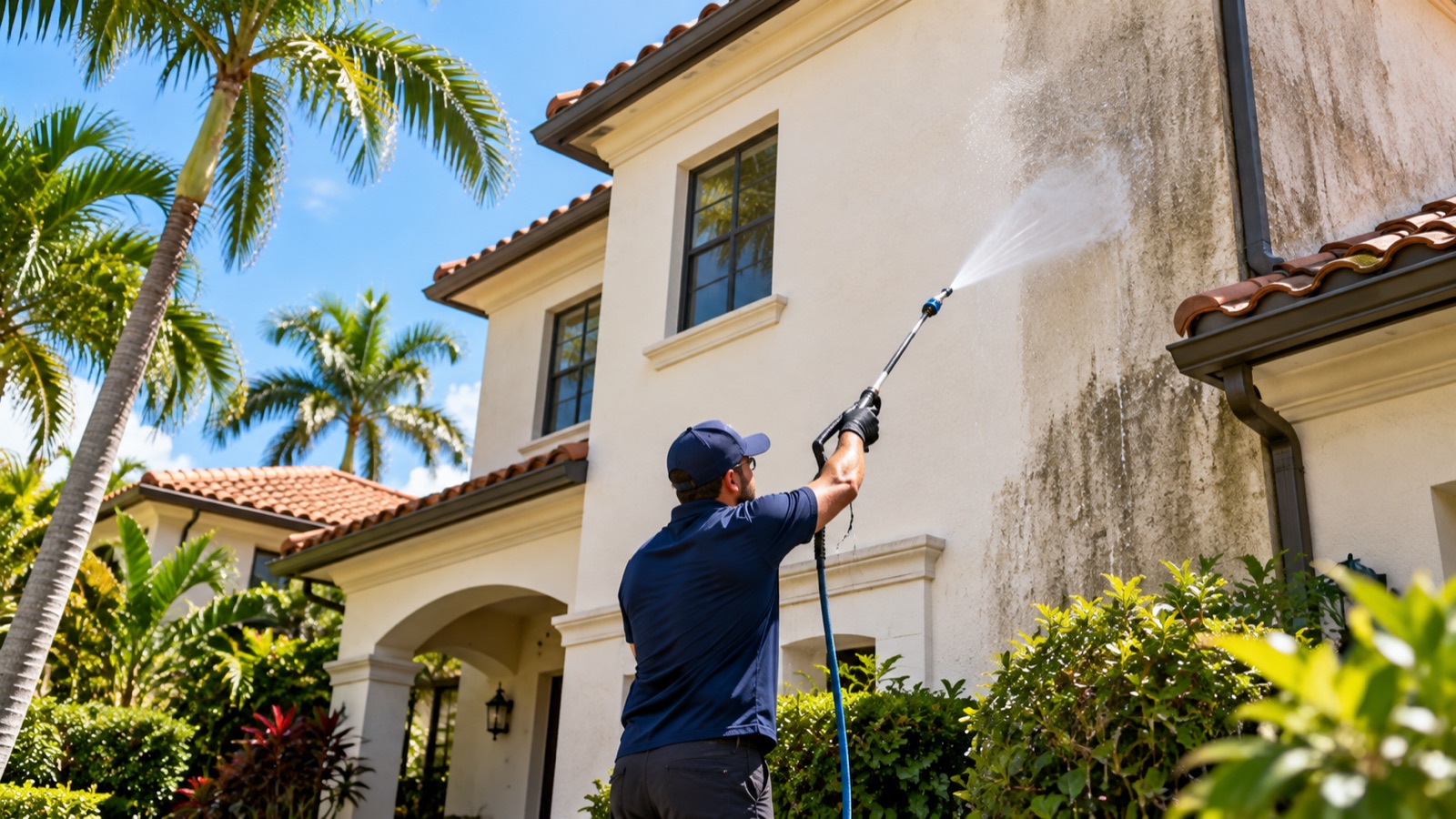
What Soft Washing Actually Is
Most people hear "pressure washing" and assume every exterior cleaning job is the same thing with the dial turned up or down. It isn't. Soft washing is a fundamentally different method, and on about half the surfaces of a typical South Florida home it's the only correct one.
Pressure washing removes material with force - 2,000 to 4,000 PSI driving dirt off concrete. Soft washing removes it with chemistry. The pressure is around 100 PSI or less, comparable to a garden hose. A cleaning solution does the work; the water only carries it on and rinses it off.
The distinction matters because algae, mold and mildew are living organisms. Blasting them off a surface removes what you can see and leaves the root structure behind in the pores. It regrows - often faster, because the surface is now more porous than before. Soft washing kills the organism, so the surface stays clean substantially longer.
Which Surfaces Need It
Anything porous, painted, delicate, or biologically colonised:
Roofs - tile and shingle, without exception. High pressure strips granules off shingles, cracks and displaces barrel tile, and voids most manufacturer warranties. See our roof soft washing service.
Stucco - porous by design. Pressure forces water into the wall and can blow out sections of the finish. Extremely common on Miami homes and extremely commonly damaged. See house soft washing.
Painted surfaces and siding - pressure lifts paint and drives water behind vinyl and aluminum panels.
Screen enclosures and pool cages - screens tear and frame fasteners don't take the force. Low pressure and solution only.
Wood fences and decks - pressure carves out the soft grain between the harder rings, leaving a furry, splintered surface that can't be undone.
Why South Florida Is Different
Miami-Dade and Broward average over 60 inches of rain a year, with heat and humidity that never fully break and salt in the air near the coast. That's close to ideal for biological growth. The organisms most commonly responsible here are Gloeocapsa magma on roofs - the black streaking you see across the county - and general mold and mildew on shaded stucco.
These aren't dirt. You cannot rinse them off, and removing the visible layer without killing the organism buys a few months at most. That's the specific reason soft washing matters more in this climate than almost anywhere else in the country.
What We Actually Do
We match solution strength and dwell time to the surface and the severity of the growth, then rinse thoroughly. On roofs the solution is applied at low pressure and left to work; you'll often see continued lightening for a week or two afterwards as rain carries dead material away. That's normal and expected.
Landscaping gets pre-wet and rinsed. Electrical and any failed window seals get covered and avoided. We don't walk tile roofs where it can be avoided, because walking barrel tile breaks barrel tile.
How to Check a Contractor Is Really Soft Washing
Two questions, before anyone starts.
"What PSI are you running on this surface?" If the answer is the same number for the driveway and the roof, walk away.
"What solution are you using?" A real soft wash uses a cleaning solution. If someone says they'll soft wash your roof with plain water at low pressure, that's rinsing - and the streaks return within months.
The clearest warning sign is anyone who quotes a whole property without asking what the surfaces are made of. Travertine, barrel tile, stucco and concrete are four different problems.
Pricing
Roof soft washing starts at $299; full house exterior soft wash starts at $249. Both are quoted flat after we know the size, surface and condition - you get the number before we schedule, not after we finish. Send photos through the quote form for an exact price.